field report
How does a summer install actually go when the venue has no cooler and no shade?
Notes from a hot outdoor build: hydration timing, which varieties collapse first, van heat management and the design choices that hold up through a full afternoon.
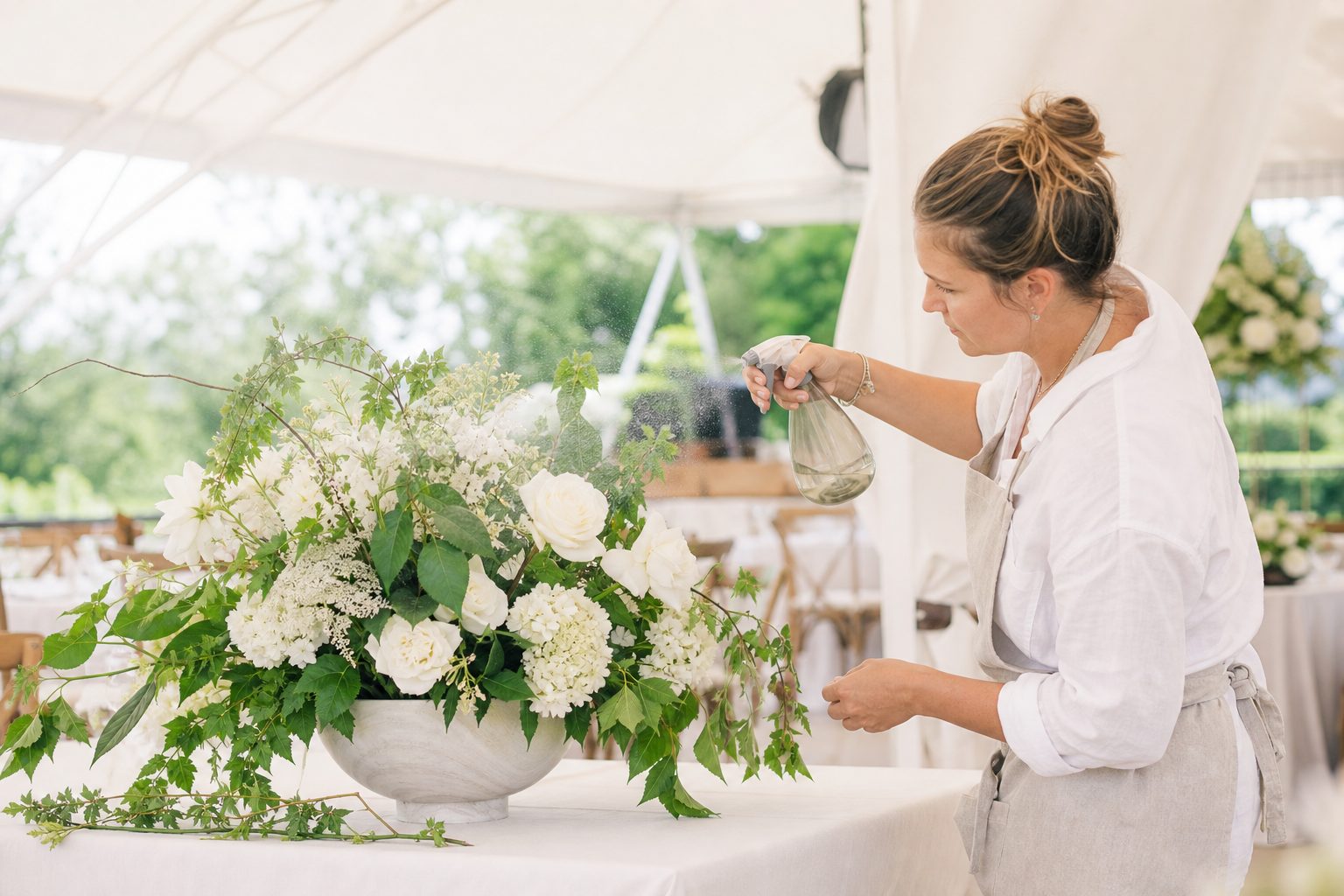
It goes better than you expect, if the work happened three days earlier. A hot outdoor build with no cooler and no shade is won in conditioning, in variety selection and in the order you stage the day. It is lost by arriving at eleven in the morning with fully open blooms in a hot van and no plan for water.
The short version from a July build at a vineyard, ninety four degrees, no indoor space, one canopy of oak at the far end of the property, ceremony at five thirty: everything held except the two varieties that were always going to be a gamble. Nothing collapsed because nothing was asked to sit in direct sun for more than forty minutes.
Here is how the days around it actually ran, and what got written into the contract afterward.
Conditioning and hydration in the days before a hot build
Product landed Wednesday for a Saturday event. Everything came out of the box, got a fresh angled cut under running water, and went into clean buckets with hydration solution, in a cooler around 36 to 38 degrees.
The rule for a hot build is that you want flowers fully hydrated but not fully open. That means ordering slightly tighter than usual and buying yourself the option to open things gently on Friday with warmer water and a warmer room, rather than needing to hold back blooms that arrived already blown.
Thursday was strictly hydration. No processing, no design, nothing out of cold air. Friday morning the greenery was cut and conditioned, and design started on the pieces that hold longest.
What gets built when
- Friday morning: garlands, greenery installs, anything foliage dominant
- Friday afternoon: reception centerpieces, back into the cooler overnight
- Saturday before dawn: personal flowers, bouquets, boutonnieres
- Saturday on site: the ceremony focal, assembled at the venue
Boutonnieres got made Saturday morning, wrapped in damp paper towel at the stem end, and stored in a lidded container. A boutonniere made Thursday is a brown boutonniere by five.
Keep reading: How do I build a stem count recipe for a bridal bouquet before I quote the price?
Which varieties wilt first and what to swap in
Heat sorts flowers quickly, and the pattern is consistent enough to plan around. Anything with a soft, thin stem and a high water demand goes first.
| Struggles in heat | Holds up better |
|---|---|
| Hydrangea | Ranunculus in cooler months, protea and banksia in heat |
| Dahlias | Standard and spray roses |
| Sweet peas and anemones | Lisianthus |
| Garden roses fully open | Garden roses cut tighter, opened on site |
| Soft herbs like mint and basil | Eucalyptus, olive, ruscus, leather leaf |
Hydrangea is the one clients ask for and the one that punishes you. If it must appear, it goes in a deep water vessel only, never in a hand tied bouquet held for an hour, and never on an arch. A hydrangea head submerged upside down in cool water for twenty minutes will often revive once, and only once.
Dahlias were used on this build, but only in the reception pieces that stayed under the tent, and they were sourced with the client warned in writing that they would look different at nine at night than at five.
Van loading, ice and transit temperature
The van ran with the air conditioning on high for twenty minutes before a single bucket went in. Cargo bays hold heat, and loading into a hot van undoes three days of cold storage in the first fifteen minutes.
Frozen gallon jugs, not loose ice, went into the footwells and between buckets. Loose ice melts into a sloshing mess that soaks boxes and slides on a turn. Jugs stay put, last longer, and you get cold drinking water for the crew by mid afternoon.
Moving blankets went over the buckets, white side out where possible, and the van was parked in shade at every stop. The finished pieces rode first, deepest, and coldest.
Keep reading: What is the real difference between a wholesale line, a local grower and a flower market?
Staging in the only shade the venue has
Scout shade before the day. On this property the usable shade was one oak at the far end of a gravel lot, roughly two hundred feet from the ceremony site. That distance is a real cost and it belongs in the install estimate.
A pop up canopy solves this and should live in the van from May through September. Ten by ten, white, with sandbags because a canopy on grass in an afternoon breeze becomes a hazard. Under it: folding tables, buckets of cool water, the toolbox and the crew's water.
Nothing sits on gravel or asphalt. Radiant heat off a parking surface cooks a bucket from below. Tables or a tarp, always.
Water sources, foam alternatives and reservoir mechanics
Find the water spigot before you need it, and test it. Vineyards and barns often have irrigation lines that run brown for the first ninety seconds, or a hose bib with no threading that fits your adapter. Carry a hose, a splitter and a set of adapters.
Reservoir mechanics matter more in heat than anywhere else. Chicken wire in a lined vessel with a full water reservoir will outperform any foam substitute in ninety degree air, because the stems are drinking from a real volume of water rather than a saturated block that is evaporating on all sides.
For an arch, that means water tubes on individual focal stems, or a rail with attached water cages, and greenery that is genuinely drought tolerant carrying the structure. Design a hot weather arch so the flowers are guests on a foliage frame, not the frame itself.
Misting helps less than people think and stains more than people admit. A fine mist on foliage is fine. Misting open white roses gives you translucent brown edges within an hour. Water the reservoir, not the petals.
See how StemCount handles this for wedding and event floristry
Timing the ceremony install as late as the venue allows
This is the single biggest lever. Every hour a finished ceremony piece spends in direct afternoon sun is an hour of visible decline, so you install as late as the venue and the photographer will tolerate.
On this build, the negotiated sequence was: arrive at one, stage under the canopy, build the arch structure and foliage at two thirty, add all focal florals from three forty five, done and clear by four fifteen, guests at five. That is a ninety minute exposure for the flowers instead of four hours.
The photographer needs detail shots, so tell them your finish time early and they will plan around it. Coordinators will often push for an earlier finish out of habit. Push back with the reason, because "the flowers will be brown in your photos" is an argument every vendor understands.
Debrief: what to write into the next hot weather contract
After the strike, before the next proposal, the notes turned into contract language. Specifically:
- A substitution clause naming heat as a cause, allowing swaps of equal or greater value without prior approval on the day
- A written acknowledgment that hydrangea, dahlias and sweet peas in outdoor summer conditions carry a performance risk the studio does not warrant
- A shade and water requirement: the venue or client provides access to a working water source and permits a staging canopy
- A late install window as a stated condition, not a request, for outdoor ceremonies between June and September
- An extended install fee for any site where staging is more than one hundred feet from the build location
- Crew provisions billed as a line: water, electrolytes and shade breaks, because a heat exhausted crew is an unfinished install
None of that language is adversarial. It reads as expertise, and clients respond to it that way.
Where the plan lives
A hot build runs on a plan that connects the recipe to the clock: what gets built Friday, what gets built at dawn, what gets assembled on site at three forty five, and how much water the whole thing needs.
StemCount holds that in one place. The recipe carries the stem counts and the substitutions, the wholesale order goes out against it, and the delivery day timeline sets the staging and install sequence for your crew. Build your next summer wedding in it and put the late install window on the page before anyone argues about it.
Read also
How do I build a stem count recipe for a bridal bouquet before I quote the price?
A recipe starts with focal, secondary, filler and greenery counts, then converts to wholesale bunches. Here is how to build one that survives substitutions and a real quote.
What is the real difference between a wholesale line, a local grower and a flower market?
Three sourcing channels, three different cost structures, minimums and lead times. A side by side look at what each one actually asks of a small wedding studio.

Which quoting mistakes cost wedding florists the most profit on a full service event?
Most lost margin on a wedding is not in the flowers. It hides in unpriced labor, hard goods treated as free and a proposal that never closed the substitution door.