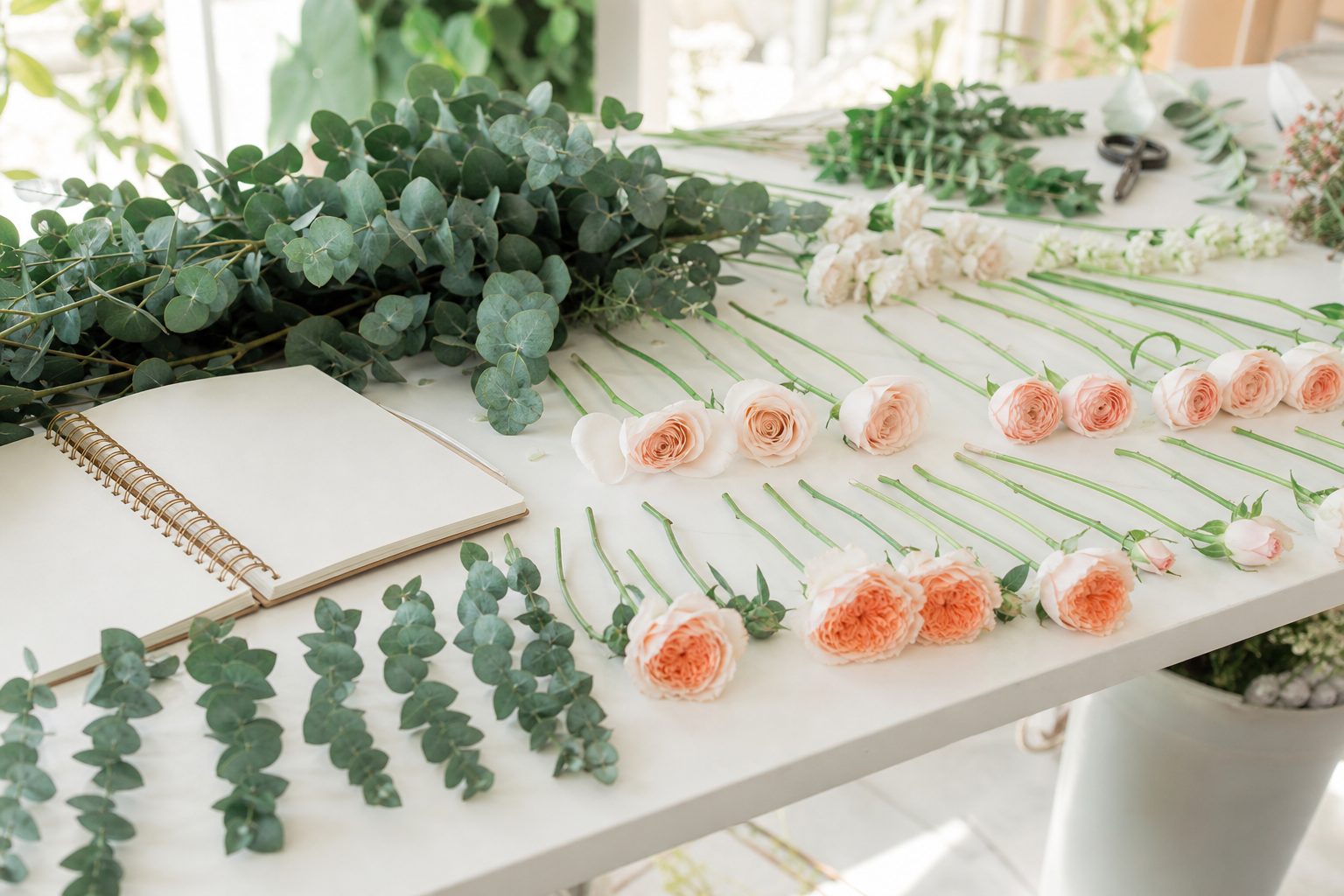
Quoting from a photo
A lush centerpiece in an inspiration image can hide sixty stems. Quoting by eye, most florists come in fifteen to twenty percent under what the recipe actually costs.
About $840 lost per wedding
Wedding and event floristry
StemCount turns every arrangement into a recipe with a stem count, a wholesale cost and your markup, so the proposal you send is the design you can actually deliver. When the client signs, the order list and the delivery day timeline are already written.

The margin leak
You quoted in February from a Pinterest board and a gut feeling. You bought in September at a price nobody could have predicted, and by the time the buckets were empty the job had paid you less than an ordinary Tuesday of retail work.
A lush centerpiece in an inspiration image can hide sixty stems. Quoting by eye, most florists come in fifteen to twenty percent under what the recipe actually costs.
About $840 lost per wedding
Every signed contract means reading the proposal again, counting stems by hand, and rounding up to bunch sizes at eleven at night.
Five hours per event
Garden roses move with the season and the shipping lane. Without a live stem cost, the difference between February pricing and October buying comes straight out of your pay.
9 to 22 percent cost drift
The bride adds two bridesmaids in July and the email gets buried. Nobody bills for the extra eighteen stems, the ribbon or the second delivery stop.
$310 unbilled on average
How it works
Four steps, and each one feeds the next. You never retype a stem count, and you never guess at a wholesale total again.
Name the design, list the varieties and the stem count for each, and set your labor and markup rule. The compote you have made ninety times becomes a reusable line item priced to the stem.
Drop recipes onto the event: bridal bouquet, six bridesmaids, twenty two guest tables, an arbor. StemCount totals the stems, applies your current wholesale sheet and shows the gross margin before you send anything.
The client sees a clean, branded document with designs, counts where you want them shown and a clear total. Approvals and change orders are logged with a date, so the July additions are on the invoice.
On signature, StemCount rolls every recipe into one wholesale order list rounded to bunch sizes, with hard goods separated. The delivery day timeline prints with processing, design blocks, load times and each drop address.

What is inside
Nothing here is borrowed from a generic project tool. Every screen speaks in stems, bunches, buckets, processing time and drop stops.
Record each design as varieties and counts, with foliage, hard goods, ribbon and mechanics on their own lines. Duplicate a recipe and swap two varieties when a client wants the same shape in a different palette.
Import your wholesaler price list and every recipe reprices itself the moment costs move. Flag varieties you refuse to substitute so the system warns you instead of quietly swapping them.
Stems total across every design, round to real bunch sizes and split by wholesaler, with a ten percent processing allowance you control. Send it as a PDF or paste it straight into your rep's email.
Work backward from ceremony time through load, drive, install, design blocks and processing. Print one page per event with addresses, contacts and the crew assigned to each block.
Send a branded proposal, capture the approval with a timestamp, and record the deposit and balance dates. Change orders attach to the original event so the final invoice adds up on its own.
After the wedding, log what you actually bought and what you actually spent on labor. The variance report shows which designs earn and which ones you have been underpricing for three seasons.
What changes
These are medians from 118 studios who ran a complete season on StemCount and logged their real purchase totals against the quoted totals.
Recipes priced against a live wholesale sheet close the gap between the February quote and the September invoice, which is where most of the margin used to go.
Order lists and timelines generate from the same recipes that built the proposal, so the late night recount before the wholesale deadline disappears.
Every addition is logged against the event with a date and a price, so the two extra bridesmaid bouquets reach the final invoice instead of the inbox.
Ordering from a counted list with a processing allowance you set beats ordering from memory, and studios stop finishing the weekend with four buckets of unusable stock.
What it replaces
Nearly every florist we speak with is holding a season together with four tools that do not talk to each other. Here is what each one costs you, and what takes its place.
It works until a formula breaks in row 340, or until you copy last year's tab and forget that rose prices moved eleven percent. Recipes keep the same math but repair themselves when costs change, and they carry a history so you can see what a design cost you last October.
Beautiful, slow, and completely disconnected from what you will buy. StemCount produces a branded proposal from the same recipes that build the order, so a change to the guest count updates the document, the stem list and the total at once.
Where the change orders live until they do not. Additions are captured against the event with a date and a price the moment you agree to them, and they appear on the balance invoice without you remembering anything.
Seven freelancers asking where to be and what to bring. One printed timeline per event, with load times, addresses, venue contacts and the design blocks each person owns, ends most of that traffic before it starts.
Capacity planning counts weekends, not months, and warns you when a Saturday already carries more installs than your crew can cover. You can see the whole booked season on one page.
Mark a variety as substitutable and record two acceptable alternatives with their own stem costs. When the market moves, the swap and the new total are one click, and the client sees a design that still reads the same.
Deposits, balances, wholesale spend and labor cost sit against each event in one export. Your bookkeeper stops asking what the March deposit from a June wedding was for.
From the studios
I had priced my signature arbor the same way for six years. The first time I entered it as a recipe I found out it took 214 stems, not the 160 I had been billing for. That single correction paid for the year.
My rep noticed first. The orders got cleaner, the bunch counts stopped being weird, and I quit calling him on Wednesday to add forty stems of eucalyptus I had forgotten. Now the list goes out Monday and it is right.
We run three installs on a Saturday in June with a crew of seven freelancers. The printed timeline with load times and drop addresses is the only reason my phone stops ringing between eight and noon.
Pricing
No percentage of your proposals, no per event fee, no charge for the freelancers you bring in for one Saturday in June.
$35
per month, one designer seat
Recommended
$79
per month, up to four seats
$159
per month, up to twelve seats
Every plan is billed monthly in US dollars and can be cancelled at any time from your account page. No annual contract, no setup fee, and you keep an export of everything you built.
Questions
Three plans, billed monthly in US dollars: Solo Florist at $35, Studio at $79 and Studio Team at $159. A user is anyone who signs in to build recipes or send quotes, so freelance designers you hire for one Saturday do not need a seat. Wholesale ordering, the delivery day timeline and unlimited client proposals are in every plan. You can move up or down a plan at the start of any billing month.
Most florists load their ten signature designs in a single afternoon, because you enter a recipe once and reuse it forever. We import your wholesaler price sheet from a CSV export so stem costs arrive already filled in. If you send us a past proposal, our team builds the first three recipes with you on a screen share. After that a new bouquet takes about four minutes.
You do. Your recipes, markups, client records and proposals belong to your studio and are never sold, shared with wholesalers or used to train anything. You can export the whole account to CSV and PDF at any time from Settings, including archived weddings. Data is stored on encrypted servers in the United States and backed up nightly.
StemCount reads price sheets from Mayesh, Kennicott, DVFlora and most local wholesalers through a CSV import, and it writes order lists back out in the format your rep expects. Proposals export as branded PDFs you can attach in any email client. There is a calendar feed for Google Calendar and Apple Calendar so delivery day timelines land next to the rest of your week. An accountant friendly export covers QuickBooks and Xero.
You cancel from your account page in two clicks and keep access until the end of the month you already paid for. There is no contract, no cancellation fee and no phone call to sit through. Before your access ends you can export every recipe, proposal and order list, so nothing is trapped. If you come back in November when the next season starts, your account is exactly where you left it.
That is precisely why stem level pricing works. A recipe records the shape of the design, thirty five garden roses, forty spray roses, eight stems of eucalyptus, and prices update the moment you refresh your wholesaler sheet. When peonies double in June, you see the new proposal total before the client does and you can swap in ranunculus with one substitution. Designers who work in substitutions rather than fixed varieties get more value here, not less.
Through the season
Wedding work is not evenly spread. It arrives in clusters of three installs on one June weekend and then goes quiet for a month. StemCount is built around that rhythm.
Three events on the same weekend roll into one consolidated stem list, split by wholesaler and rounded to the bunch. You see the total wholesale spend for the weekend before you press send.
The timeline blocks out cooler space, processing hours and who is designing what. Each design card prints with its recipe, so a freelancer can build a compote without asking you twice.
Load lists per vehicle, drive times, venue contacts and install windows sit on a single sheet on the dashboard. Anything that changes on site gets logged and lands on the final invoice.
Every screen was tested against real proposals from studios booking between twelve and ninety weddings a year. If a term does not exist in the trade, it does not appear in the interface.
Field names use the vocabulary you already use with your rep: stems, bunches, boxes, hard goods, mechanics, drop stops. Nothing is renamed to sound like enterprise software.
Some studios multiply wholesale by a fixed factor. Some price labor per stem, some per design hour, some per install crew day. All three models are built in, and you can run a different rule for retail work than for weddings.
You can also set a floor price per design so a small bridesmaid bouquet never gets quoted below what it costs you to make it.
practical guide
A recipe starts with focal, secondary, filler and greenery counts, then converts to wholesale bunches. Here is how to build one that survives substitutions and a real quote.
comparison
Three sourcing channels, three different cost structures, minimums and lead times. A side by side look at what each one actually asks of a small wedding studio.
mistakes to avoid
Most lost margin on a wedding is not in the flowers. It hides in unpriced labor, hard goods treated as free and a proposal that never closed the substitution door.
Talk to us
Send the proposal that worried you, the one where the arbor kept growing and the guest count moved twice. On a thirty minute call we will build it as recipes and show you what it should have been worth.
You will hear back from a person who has stood in a cooler at five in the morning, not from a sales script. If StemCount is not right for the way your studio works, we will say so on the call.
We answer every message ourselves, usually the same day. Prefer email? Write to jimenezjulien42@gmail.com.