practical guide
How do I build a stem count recipe for a bridal bouquet before I quote the price?
A recipe starts with focal, secondary, filler and greenery counts, then converts to wholesale bunches. Here is how to build one that survives substitutions and a real quote.
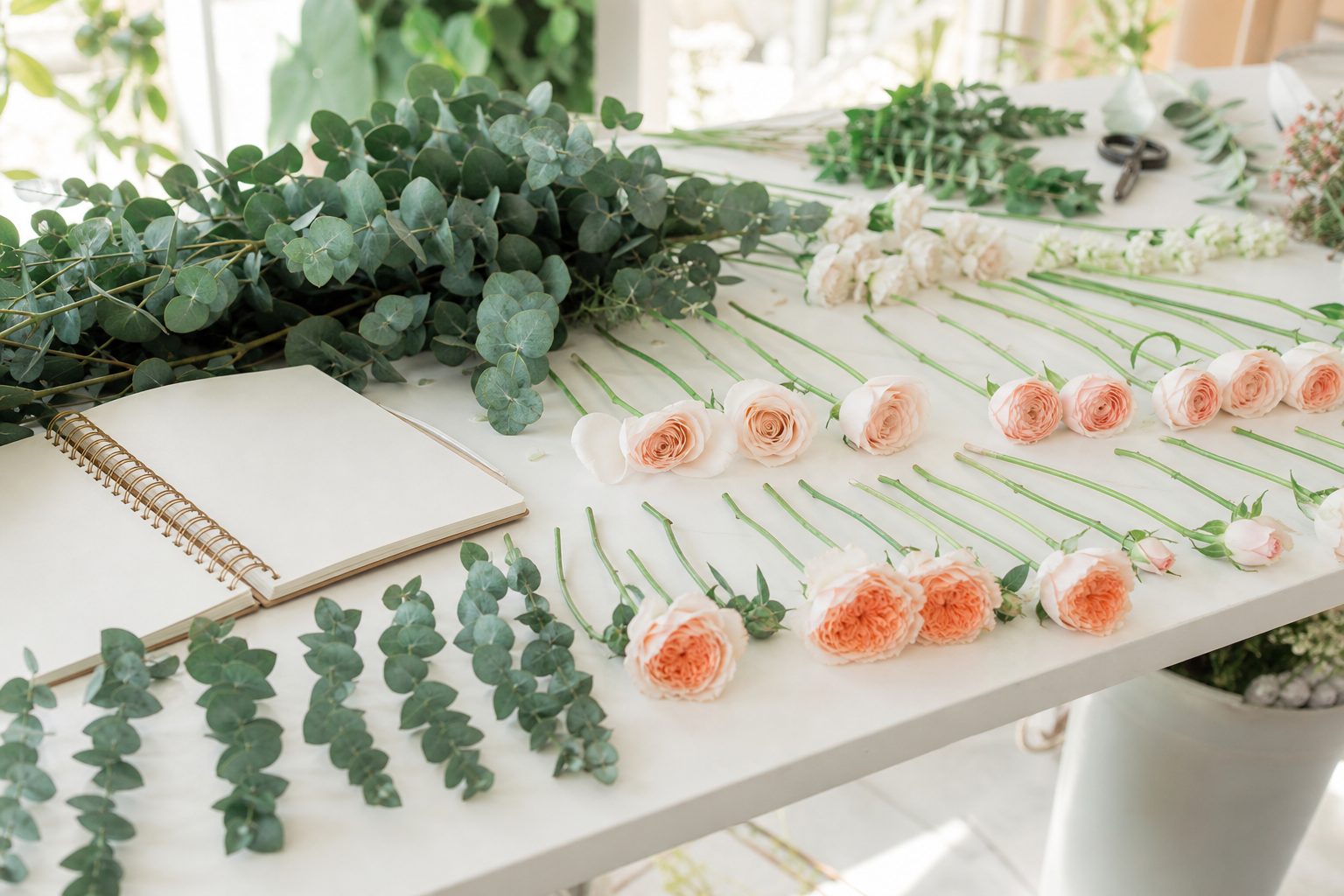
You build the recipe before the price, always. A bridal bouquet recipe is a written list of every stem that will go into the finished piece, sorted into four layers, with a count beside each one. Once you have that list, the price is arithmetic. Without it, you are quoting a photograph.
The short version: decide the finished diameter, assign counts to focal, secondary, texture and greenery in roughly a 1 to 2 to 2 to 3 ratio, add a loss allowance on top, then convert every stem line into whole wholesale bunches, because that is the unit you actually pay for. A 10 inch garden style bouquet lands somewhere near 45 to 60 stems. A 14 inch one can pass 90. The gap between those two numbers is often three hundred dollars of flower cost, and it is invisible if you quote from a mood board.
Here is how to build a recipe that holds up when the bride adds a bridesmaid, when the grower short ships your dahlias, and when you are pulling the wholesale order three weeks later and cannot remember what you meant by "some ranunculus."
Why a bouquet quote fails without a stem count
A quote built on a look has no floor. You saw an image, you felt a number, you said it out loud. If the image showed 70 stems and you priced 50, you eat the difference in your own money, and you will not find out until the bouquet is on your bench the morning of.
The failure is structural, not careless. Bouquets read by volume and by texture, and volume grows with the cube of the radius while your eye reads the flat outline. A bouquet that looks "a little bigger" in a photo can hold forty percent more material. Nobody eyeballs that correctly, including people who have made a thousand bouquets.
The second failure is the order sheet. You buy by the bunch, not the stem. If your recipe says 14 spray roses and spray roses come 10 to a bunch, you are buying 20 and paying for 20. A recipe that never touches the bunch math will under-quote every single line by the size of the leftover.
Keep reading: What is the real difference between a wholesale line, a local grower and a flower market?
The four layers of a bouquet recipe: focal, secondary, texture, greenery
Every bouquet, in every style, resolves into four jobs. Naming them keeps you from writing a recipe that is a pile of pretty names with no structure.
Focal
The largest and most expensive heads. Garden roses, peonies, dahlias, king protea, open cabbage roses. These set the price of the whole piece. Count them first and count them honestly, because they are the line that moves your cost the most per unit.
Secondary
Mid sized blooms that fill between the focals: standard roses, lisianthus, ranunculus, tulips, anemones, spray roses. Usually about twice the focal count. This layer is where you absorb a budget change without visibly shrinking the bouquet.
Texture
Small, airy, interruptive material. Astilbe, scabiosa, nigella, sweet pea, waxflower, chocolate lace, seeded bits. Texture is what separates a bouquet that reads designed from one that reads grocery. It is also usually cheap per stem and easy to under-count.
Greenery
Structure and movement. Silver dollar or seeded eucalyptus, italian ruscus, olive, jasmine vine, ferns. Greenery often comes in heavy bunches, so a bouquet rarely needs a whole bunch of anything, and the leftover belongs to the rest of the wedding.
Counting by finished diameter instead of by feel
Pick the diameter first, in inches, and write it on the recipe. Then let the count follow. This is the single change that makes recipes repeatable between designers.
These are working starting points for a garden style hand tied, the kind with visible negative space. A tight, compact, all-rose bouquet needs more stems at the same diameter. A loose, airy design needs fewer.
| Finished diameter | Focal | Secondary | Texture | Greenery | Total stems |
|---|---|---|---|---|---|
| 8 in (petite / bridesmaid) | 3 | 7 | 8 | 10 | 28 |
| 10 in (small bridal) | 5 | 11 | 13 | 16 | 45 |
| 12 in (standard bridal) | 7 | 15 | 18 | 22 | 62 |
| 14 in (full garden bridal) | 10 | 21 | 26 | 31 | 88 |
| 16 in (statement / cascade) | 14 | 28 | 34 | 42 | 118 |
These are assumptions, not measurements from a study, and you should adjust them against your own last five bouquets. The point is not that 12 inches equals 62 stems in every studio. The point is that once you have your own version of this table, you stop re-deciding from scratch on every inquiry.
Calibrate it once. Next time you make a bridal bouquet, count every stem as it goes in, keep a tally on a piece of tape on the bench, then measure the finished head across the widest point. Do that three times and you own a table that is true for your hands.
Keep reading: Which quoting mistakes cost wedding florists the most profit on a full service event?
Converting stems into wholesale bunch quantities
This is where the recipe becomes money. Take each line, divide by the pack size, and round up to a whole bunch. Never round down and never assume you will "borrow from the centerpieces" unless the centerpiece recipe says so explicitly.
A worked example, a 12 inch bridal bouquet, prices used here as illustrative wholesale figures you should replace with your own current quotes:
| Item | Stems needed | Pack size | Bunches to buy | Cost per bunch | Line cost |
|---|---|---|---|---|---|
| Garden rose, cream | 7 | 10 | 1 | $48.00 | $48.00 |
| Lisianthus, blush | 9 | 10 | 1 | $22.00 | $22.00 |
| Spray rose, peach | 6 | 10 | 1 | $18.00 | $18.00 |
| Scabiosa | 10 | 10 | 1 | $16.00 | $16.00 |
| Astilbe | 8 | 10 | 1 | $26.00 | $26.00 |
| Seeded eucalyptus | 12 | 20 | 1 | $19.00 | $19.00 |
| Italian ruscus | 10 | 25 | 1 | $14.00 | $14.00 |
Purchased cost, $163.00. Stems actually used, 62. Stems purchased, 95. That leftover of 33 stems is not waste yet, it is inventory, and whether it stays inventory depends entirely on whether the rest of the wedding uses the same palette.
If this bouquet were the only piece on the order, your true flower cost is $163.00, not the $101.00 you would get by pricing 62 stems at their per stem rate. Quoting the per stem math on a standalone bouquet is how a florist works a Saturday for nothing.
Building shrinkage and breakage into the count
Some stems never make it into the bouquet. Blown heads, bent necks, a rose that opened three days early, one you snap while wiring. This is real and it is predictable enough to budget.
Use a loss allowance by category rather than one flat percentage, because a peony and a stem of ruscus do not fail at the same rate:
- Delicate focals (peony, dahlia, garden rose, anemone): add 15 percent
- Standard blooms (rose, lisianthus, tulip, ranunculus): add 10 percent
- Texture and airy stems: add 10 percent, more if shipped from far
- Greenery: add 5 percent
Apply the allowance to the stem count before you convert to bunches, not after. Seven garden roses plus 15 percent is 8.05, call it 8, still one bunch of 10. Often the allowance costs you nothing because the bunch rounding already covered it. When it does push you into a second bunch, that is exactly the case you needed to catch at quote time and not at 6am on delivery day.
See how StemCount handles this for wedding and event floristry
Naming substitution tiers inside the recipe
Write the substitute into the recipe the day you write the recipe. Not in an email later, not in your head. Every focal and secondary line gets a first choice and a named alternate at a comparable price point.
Three tiers is enough:
- Preferred. The named variety. Quoted at its cost.
- Equivalent. Same color family, same visual weight, same or lower wholesale cost. Cream garden rose swaps to cream standard rose plus one extra stem for volume.
- Structural. What you use when the whole category fails, for example a hard freeze takes out ranunculus regionally. Usually a different flower with a similar job.
Then put a plain sentence in the proposal: flowers are a seasonal agricultural product, and substitutions of equal or greater value within the stated palette may be made without notice. A client who has read that sentence and signed under it does not send a Sunday morning message about the ranunculus.
Reusing the recipe across a full wedding order
The bridal bouquet recipe is the parent document for the whole event. Everything else scales off it.
Bridesmaid bouquets are typically 55 to 65 percent of the bridal stem count at the same palette. Boutonnieres take one focal head or bud, one texture bit and two small greens. A bud vase is three to five stems. A low centerpiece in a 6 inch compote is roughly the same total as a 10 inch bouquet, since the mechanics hold volume the bouquet does not.
Once every piece is expressed in the same seven ingredient lines, you consolidate. Those 33 leftover stems from the bouquet stop being waste and become the boutonnieres and two bud vases. Consolidation is where the real margin sits on a full service event, and it only exists if every piece was written as counted stems in the first place.
Order the whole event as one purchase, never piece by piece. Add the recipes, add the loss allowances, then round to bunches once at the bottom. Rounding at every piece separately can add fifteen or twenty percent to your wholesale bill for no visible reason.
Where to go from here
Build one recipe by hand this week, on the next bouquet you make, and calibrate your own diameter table from it. That single sheet will change what you quote next month more than any pricing formula will.
The part worth automating is the arithmetic underneath: the loss allowance, the bunch rounding, the consolidation across twenty pieces, and the wholesale order list that falls out the other side. That is what StemCount does. You write the recipe once, it holds the counts, converts them into whole bunches at your suppliers' pack sizes, and prices the event from the real stems instead of the guess. Start with your next inquiry and quote it both ways. The difference is usually the profit.
Read also
What is the real difference between a wholesale line, a local grower and a flower market?
Three sourcing channels, three different cost structures, minimums and lead times. A side by side look at what each one actually asks of a small wedding studio.

Which quoting mistakes cost wedding florists the most profit on a full service event?
Most lost margin on a wedding is not in the flowers. It hides in unpriced labor, hard goods treated as free and a proposal that never closed the substitution door.
What licenses, sales tax rules and insurance do I need to run a wedding floral studio?
Resale certificates, sales tax on labor and rentals, venue certificates of insurance and vehicle coverage. A plain look at the paperwork a US floral studio is asked for.