comparison
What is the real difference between a wholesale line, a local grower and a flower market?
Three sourcing channels, three different cost structures, minimums and lead times. A side by side look at what each one actually asks of a small wedding studio.
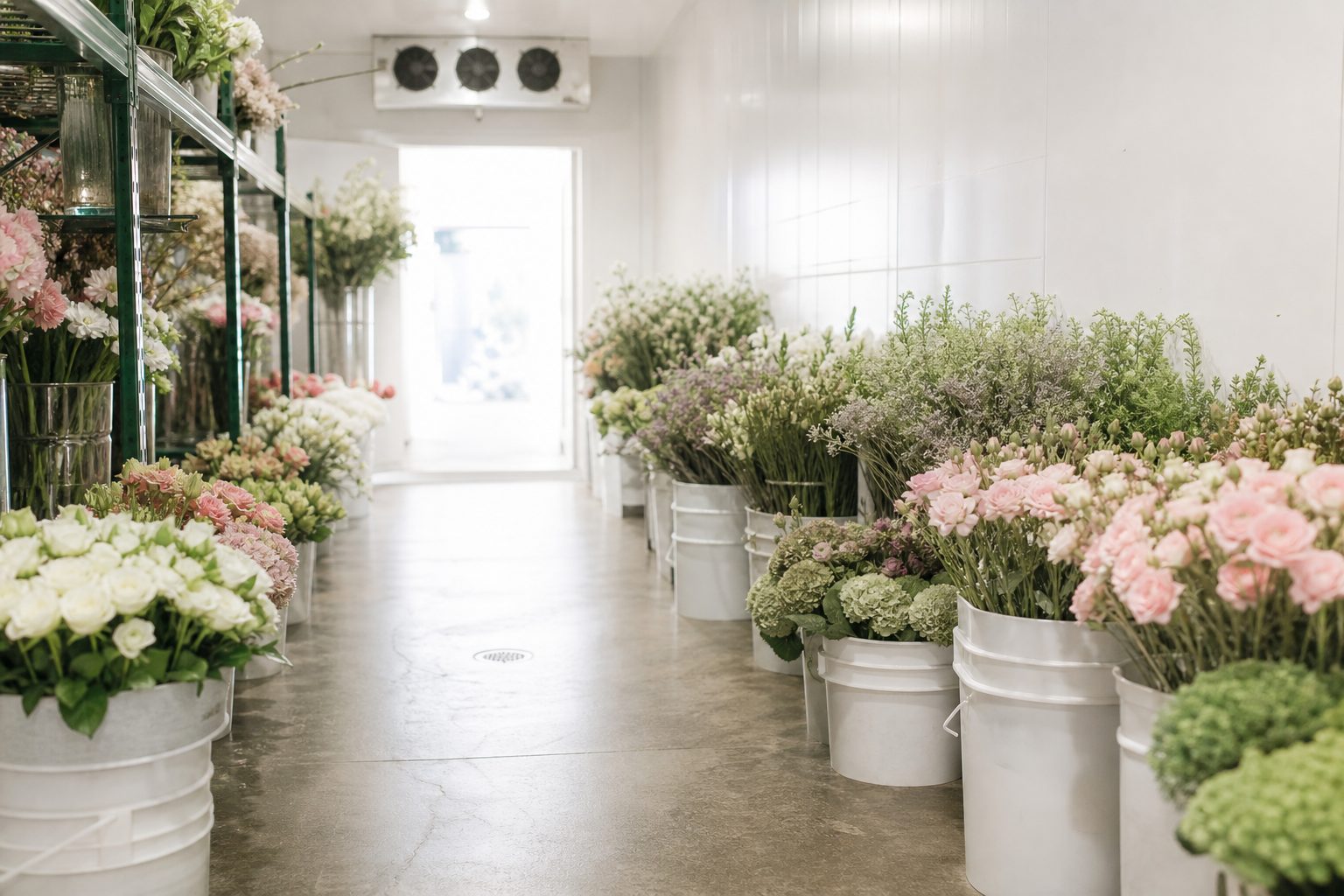
They differ in three things that matter to your P&L: what unit they sell you, how far in advance they will commit, and who absorbs the loss when the product is bad. A wholesale line sells sealed boxes at a fixed count, books eight to twelve weeks out, and will credit a documented bad box. A local grower sells by the bunch at harvest, commits to a color story rather than a variety, and cannot credit you for weather. A flower market sells whatever is in the cooler today, at market price, with no commitment and no recourse at all.
None of them is the right answer for a whole wedding. Most experienced studios run all three on one event, deliberately, with each channel doing the job it is actually good at. The mistake is not choosing wrong. The mistake is treating them as interchangeable price quotes when their cost structures are not comparable.
Here is what each one actually asks of you.
How each channel prices: box, bunch and standing order
The pricing unit is the first real difference, and it is the one that quietly breaks budgets.
The wholesale line, meaning a national importer or a box program that ships direct from the farm, prices per box or per bunch inside a box. A box of roses is a fixed count, often 100 or 125 stems, sometimes split as 10 bunches of 10 or 25 bunches of 25 depending on the variety and the farm. You buy the box. There is no half box on most items.
The local grower prices per bunch, and bunch means whatever that farm packs, which might be 10 stems of dahlias or a loose armload of cosmos. Ask for the count in writing. A field grown bunch is rarely the same count as an imported bunch of the same flower, so a recipe built on import pack sizes will misprice a grower order.
The flower market or local cash-and-carry wholesaler prices per bunch too, but at a spot price that moves with the week. The same bunch of eucalyptus can cost $14 in October and $24 the week before Valentine's Day. Market pricing is the most flexible and the least predictable, which is a poor combination for an event you quoted six months ago.
A standing order sits across all three: you commit to a set quantity weekly or monthly for a lower price and priority allocation. It only pays if your volume is genuinely steady. Six weddings in May and one in February is not steady.
Keep reading: Which quoting mistakes cost wedding florists the most profit on a full service event?
Minimum orders and case break rules
The minimum is what turns a good unit price into a bad total price.
| Wholesale line | Local grower | Flower market | |
|---|---|---|---|
| Typical minimum | Full box, or a dollar floor per order | Often a dollar floor, sometimes none | One bunch |
| Case break available | Rarely, and at a premium | Not applicable | Not applicable |
| Mixed box option | Sometimes, at higher per stem cost | Yes, farmer's choice mixes | Yes, by definition |
| Best for | High count repeated items | Focal and seasonal specialty | Small gaps and last minute |
Work the arithmetic before you decide. Say you need 60 stems of white standard rose. The line sells a 100 stem box at $95, which is $0.95 a stem. The market sells bunches of 25 at $32, which is $1.28 a stem. The line looks cheaper by a third.
But you only need 60. From the line you pay $95 and hold 40 stems you may not use. From the market you buy three bunches, 75 stems, for $96. Same money, less dead stock. The line only wins if those 40 extra stems have a job on this event or the one next weekend.
The rule: a channel with a large minimum is cheaper only when your required quantity is at least about 80 percent of the minimum unit. Below that, the per stem price is fiction.
Lead times and how far ahead each channel locks
Lead time is not just when the flowers arrive. It is when the price and the availability stop being able to change on you.
- Wholesale line, pre-book: place eight to twelve weeks out for named varieties, longer for holiday weeks and for specialty roses. This is the only channel that will hold a specific variety in a specific color months ahead.
- Wholesale line, open market: order roughly seven to ten days out, ship for arrival two to three days before the event. Availability is whatever the farms have.
- Local grower: talk in the winter about the season, confirm the actual crop two to three weeks out, and accept the final list the week of. Growers commit to color and category early, variety late.
- Flower market: zero lead time and zero commitment. What is in the cooler Wednesday morning is what exists.
Build your timeline backward from the event. Arrival two to three days ahead for hydrating and opening, one more day of cushion for anything that ships. A Saturday wedding with a Wednesday arrival means the reorder window closes Monday, and Monday is when you need to know a box is short, not Thursday.
Keep reading: What licenses, sales tax rules and insurance do I need to run a wedding floral studio?
Quality control and what recourse you have on a bad box
This is the difference nobody discusses at inquiry stage and everybody discovers at 7am.
With a wholesale line, you have a claims process. Photograph the box unopened with the label visible, photograph the damage, note the box and farm code, and file inside the window, usually 24 hours from delivery. Credits are normal for botrytis, freeze damage, short count and heads that never open.
With a local grower, there is no claims department. What you have is a relationship and, if the crop failed, an apology. A good grower will call you early and offer what they do have. That is the whole remedy. Price this in by never letting a single grower own an irreplaceable element.
With the market, you inspected it yourself in the cooler and you carried it out. That is the transaction. Recourse is essentially zero, which is precisely why market buying is best for material you can see and judge on the spot.
The practical decision rule: put anything the client can name and will look for at the wholesale line, where you have both a pre-book and a claim. Put anything that is texture, filler or greenery wherever it is best that week.
Seasonality and what a local grower can and cannot promise
A grower can promise a category and a window. Dahlias from late July through first frost. Peonies for roughly three weeks, and the date of those three weeks moves with the spring. Ranunculus and anemone through cool months under cover.
A grower cannot promise a specific variety on a specific Saturday six months out. Not because they are unreliable but because they are farming. A hot week pushes the whole field forward by ten days and a cold one holds it back.
So write grower material into the recipe as a role, not a name. "Local seasonal focal, garden style, cream to blush, 7 stems" is a line a farm can fill. "Cafe au Lait dahlia, 7 stems, June 14" is a line that may simply not exist that day, and it puts your client's expectation somewhere your supply cannot reach.
The upside is worth the flexibility. Field grown material was cut hours ago rather than five days and a flight ago, and it holds. Scent, movement and unusual varieties are where local wins outright.
See how StemCount handles this for wedding and event floristry
Freight, fuel surcharges and pickup time cost
The landed cost is the only cost. Add freight, surcharges, and your own time to every quoted price before comparing.
Shipped boxes carry a per box freight charge plus, frequently, a fuel or cold chain surcharge that moves quarterly. A $95 box with $28 freight is a $123 box, and that is $1.23 a stem, not $0.95. Consolidating into fewer, fuller boxes is the main lever you control.
Pickup is not free either. A market run that costs you two and a half hours door to door, at a $45 an hour loaded labor rate, is $112 of labor, plus mileage. At the federal business mileage rate, a 40 mile round trip runs roughly $27. So that market run carries around $139 of cost before you buy a single stem. Two runs a week for a wedding is $278 that has to sit somewhere in the quote.
Assign it deliberately. Either build a sourcing line into the event, or fold it into your labor rate, but do not let it vanish. A studio that makes three market runs per wedding and prices none of them is donating most of a day.
Blending channels for one wedding without double buying
The whole point of understanding the three channels is to use them together on one consolidated buy. Do it in this order:
- Finalize every recipe first and total the stems by ingredient across all pieces, so you are buying for the event, not for a bouquet.
- Pre-book the named focals at the line, the items the client will look for by name and that need to survive a claim.
- Assign seasonal specialty to the grower by role, with a color and a category, not a cultivar.
- Leave a deliberate gap for market, usually texture and part of the greenery, sized at maybe 15 to 20 percent of the stem count.
- Round to whole units once, at the very bottom, after everything is consolidated.
- Write the overlap down. If both the line and the market can cover eucalyptus, mark which one owns it, so you do not buy it twice on Wednesday because you forgot Monday's order.
Step six is where most double buying happens. It is not a knowledge problem, it is a tracking problem across three order sheets written on three different days.
Putting it to work
Take your next event and split the ingredient list across the three channels on paper before you place anything. Compare landed cost per stem, not sticker price, and check every minimum against the 80 percent rule above.
Doing that by hand for twenty pieces and three suppliers is the tedious part. StemCount holds the recipes, totals the stems across the whole event, applies each supplier's pack size and minimum, and produces one order list per channel, so the overlap is visible before you buy it twice. Build your next wedding order that way and see what the consolidated number looks like against what you would have spent.
Read also

Which quoting mistakes cost wedding florists the most profit on a full service event?
Most lost margin on a wedding is not in the flowers. It hides in unpriced labor, hard goods treated as free and a proposal that never closed the substitution door.

What licenses, sales tax rules and insurance do I need to run a wedding floral studio?
Resale certificates, sales tax on labor and rentals, venue certificates of insurance and vehicle coverage. A plain look at the paperwork a US floral studio is asked for.
How did one studio rebuild a two hundred guest wedding order after a shipment arrived short?
A focal variety arrives half short two days out. Follow the recount, the substitution call, the client conversation and the credit claim that kept the design intact.